



Decoding HashKey's Prospectus: The Real Ledger of Hong Kong's First Crypto Asset Stock
TechFlow Selected TechFlow Selected
Decoding HashKey's Prospectus: The Real Ledger of Hong Kong's First Crypto Asset Stock
This document answers the question "Who is HashKey," but the question "How much is it worth?" must await the market's answer.
 Navigating Web3 tides with focused insights
Author: David, TechFlow
HashKey is going public.
On December 1st, Hong Kong's largest licensed crypto exchange passed the hearing of the Hong Kong Stock Exchange, officially entering the IPO sprint stage. J.P. Morgan, Guotai Haitong, and Guotai Junan International are acting as joint sponsors.
The so-called "hearing" is a key milestone in the Hong Kong stock listing process. The Listing Committee reviews the company's application materials. Passing it means the main regulatory hurdles have been cleared, and the next steps are pricing, roadshows, and listing.
From an industry perspective, this will be Hong Kong's second crypto asset-related company to list on the HKEX after OSL. However, their positioning differs:
OSL leans more towards institutional custody and brokerage services, while HashKey started as a retail exchange, has a broader business line, and faces the cyclical volatility of the crypto market more directly.
The Prospectus (Post-Hearing Information Set) is the most solid material for understanding a company. This article will dissect key information from this document across several dimensions: revenue structure, financial performance, user data, and shareholding structure.

Business Overview: More Than Just an Exchange
Many people's perception of HashKey stops at "Hong Kong's licensed exchange," but the picture revealed by the prospectus is much more complex.
HashKey defines itself as a "comprehensive digital asset company," with its business architecture revolving around three main pillars: Transaction Facilitation Services, On-Chain Services, and Asset Management Services.
Clearly, HashKey is attempting to build a digital asset ecosystem covering the entire chain of "Trading-Custody-Staking-Asset Management".
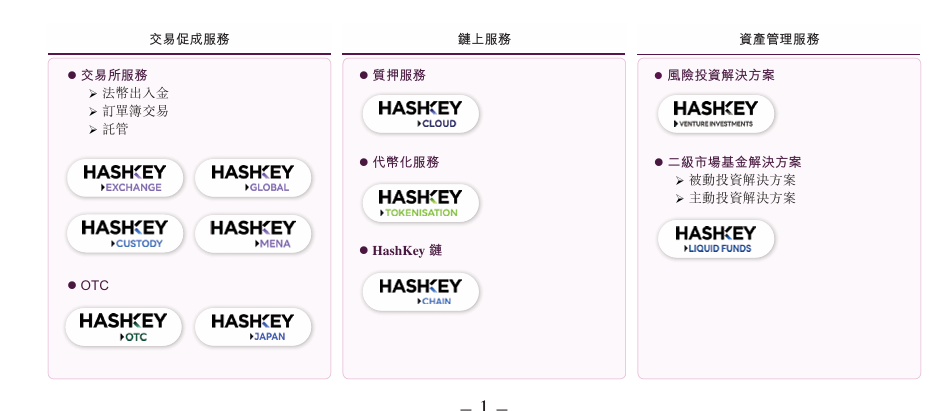
Transaction Facilitation is the foundation. This includes the familiar spot exchange as well as OTC services for large-volume trades.
As of September 2025, the platform has cumulatively facilitated spot transactions worth HKD 1.3 trillion, with platform assets under custody reaching HKD 19.9 billion. Based on 2024 trading volume, HashKey is Hong Kong's largest licensed platform with a market share exceeding 75%, and also the largest regional onshore platform in Asia.
On-Chain Services are the differentiator. This line includes three areas: Staking Services, Tokenization Services, and the self-built HashKey Chain (an L2).
Among these, the staking business is the most substantial. As of September 2025, staked assets reached HKD 29 billion, making HashKey the largest staking service provider in Asia and ranking eighth globally.
The tokenization business focuses on bringing real-world assets (RWA) on-chain, currently primarily financial assets, with plans to expand into areas like precious metals, computing power, and green energy in the future.
Asset Management is an extension of institutionalization. HashKey manages client assets through two flagship funds. As of September 2025, the assets under management since inception amounted to HKD 7.8 billion, with over 400 investments completed. This business includes both venture capital in early-stage projects and active/passive strategies in secondary markets.
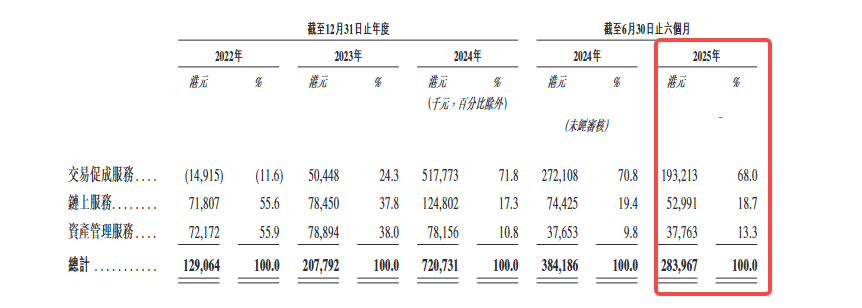
Looking at the revenue structure for the first half of 2025, Transaction Facilitation contributed 68% of revenue, On-Chain Services accounted for 18.7%, and Asset Management made up 13.3%. Trading remains the core, but the share of on-chain and asset management is gradually increasing.
Revenue Structure: Trading Accounts for Nearly 70%, Volatility Follows Closely
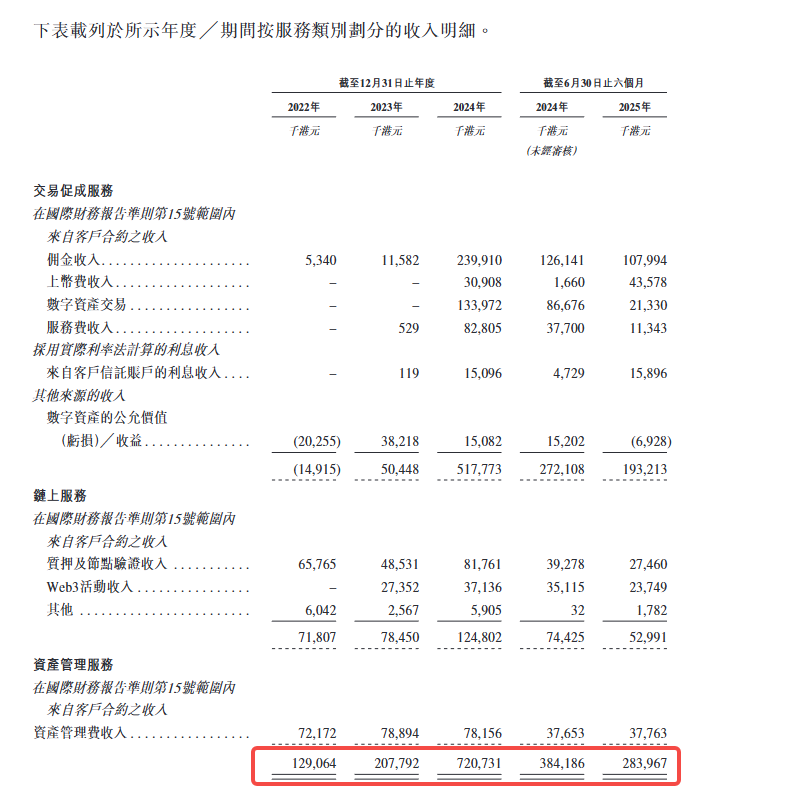
HashKey's revenue growth curve is quite steep. Revenue was HKD 129 million in 2022, increased to HKD 208 million in 2023 (up 61% year-over-year), and surged to HKD 721 million in 2024 (up 247% year-over-year).
This is a typical crypto bull market beneficiary curve.
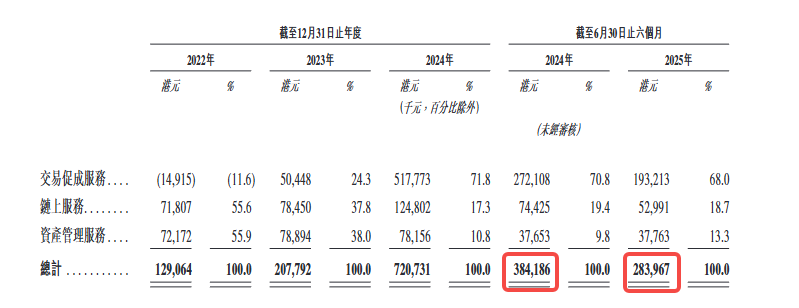
However, growth came to an abrupt halt in the first half of 2025. Revenue for this half-year was HKD 284 million, a 26% decrease year-over-year. This turning point deserves further analysis.
We can break down the financial situation of HashKey's different businesses as follows:
- Trading business is the absolute mainstay of revenue.
In the first half of 2025, Transaction Facilitation Services contributed 68% of revenue, with specific sources including trading commissions, OTC spreads, and fair value changes in digital assets. Among these, commission fees mainly come from USDT, BTC, and fiat currency trading pairs.
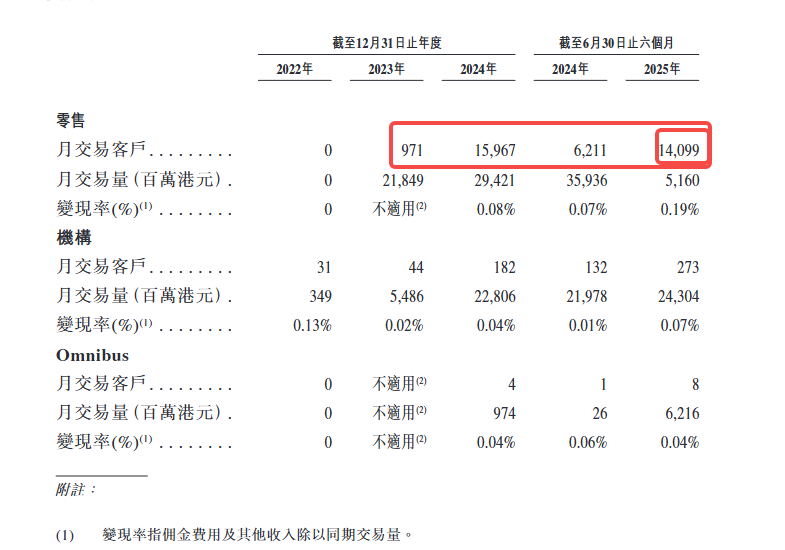
The prospectus discloses two key metrics: Monthly Trading Clients and Take Rate.
First, looking at Monthly Trading Clients, in 2024, the number of monthly trading retail clients was around 16,000; as of the first half of 2025, the number of monthly trading retail clients was around 14,000; this number is not particularly high. On the other hand, although institutional clients are fewer relative to retail clients, they contributed more trading volume in the first half of 2025.
The other metric is Take Rate, i.e., commission revenue / trading volume. The take rate for institutional clients is about 0.07%, for retail clients about 0.19%, and for Omnibus clients (clients accessed through partners) about 0.04%.
This number directly reflects HashKey's pricing power and client structure. Retail clients, while having smaller individual trade sizes, command higher fees; institutional clients have large trading volumes, but fees are compressed very low.
- Volatility in trading volume is directly transmitted to the revenue side.
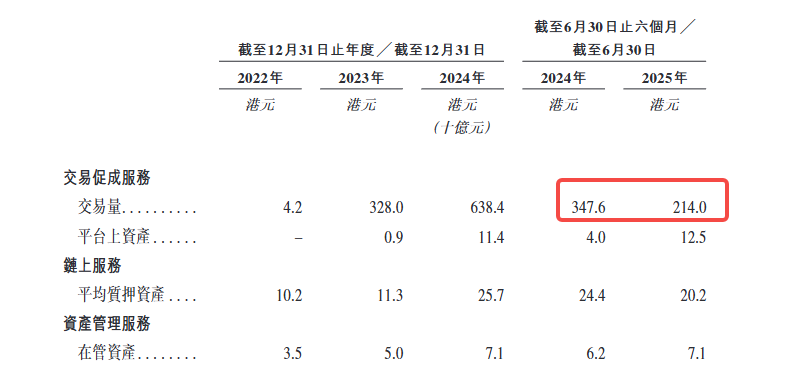
In the first half of 2024, HashKey's trading volume reached HKD 347.6 billion, but it plummeted to HKD 214 billion in the first half of 2025.
This decline has two reasons: first, overall market weakness; second, HashKey proactively scaled back its business in the Bermuda market (due to a lack of fiat on/off-ramp channels), refocusing its strategic center on Hong Kong.
- The share of On-Chain Services and Asset Management is increasing.
In the first half of 2025, On-Chain Services contributed 18.7% of revenue, and Asset Management contributed 13.3%. Revenue from On-Chain Services mainly comes from staking rewards and tokenization service fees, while Asset Management revenue comes from management fees and performance fees.
These two businesses have relatively high gross margins, but their scale is not yet sufficient to hedge against the volatility of the trading business.
The revenue structure reveals a core contradiction: HashKey's growth is highly dependent on trading volume, which in turn is highly dependent on market conditions. This is the fate of all exchanges, but for a company about to go public, this dependency means weak predictability of performance.
User Data: From 18 to 1.4469 Million Registered Users in 3 Years
HashKey's user growth speed shows a clear characteristic of accelerating in the later stages.
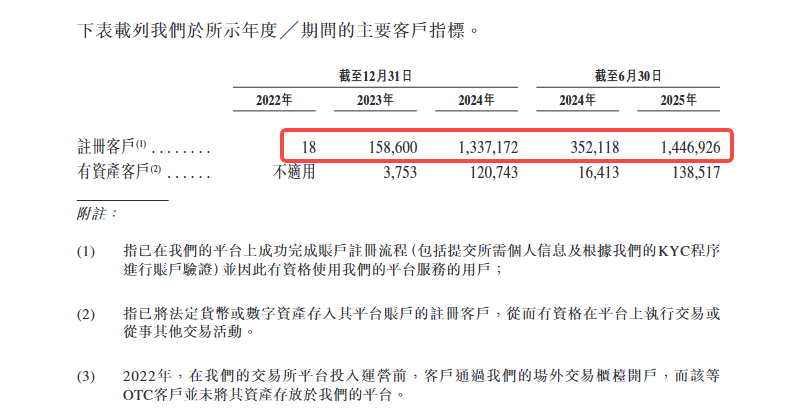
At the end of 2022, the platform had only 18 registered users; by the end of 2023, this number became 158,600; it jumped to 1.3372 million by the end of 2024; and further increased to 1.4469 million by June 2025. In two and a half years, the user base grew 80,000-fold.
However, registered users are just the surface; what's truly meaningful are "Funded Clients," i.e., users holding digital assets or fiat currency on the platform.
At the end of 2023, there were only 3,753 funded clients; this increased to 120,700 by the end of 2024; and reached 138,500 by June 2025. This conversion rate (funded clients / registered users) decreased from 2.4% at the end of 2023 to 9.6% in June 2025, indicating that a large number of new registered users completed KYC and remained.
The prospectus discloses a key metric: the retention rate for funded clients is as high as 99.9%.
This number looks impressive, but it's important to note that this is the retention of "funded clients," not necessarily active trading clients. In other words, users keep assets on the platform but may not trade frequently.
Simultaneously, the change in client structure is more noteworthy.
HashKey categorizes clients into three types: Institutional Clients, Retail Clients, and Omnibus Clients (clients accessed through partners).
Looking at the share of trading volume, the share of institutional clients has been continuously increasing: 62% in the second half of 2024, further rising to 68% in the first half of 2025. Meanwhile, retail client trading volume dropped significantly in the first half of 2025, plummeting from HKD 215.6 billion to HKD 31 billion.
This change reflects both cooling market sentiment and indicates HashKey's conscious shift towards institutionalization.
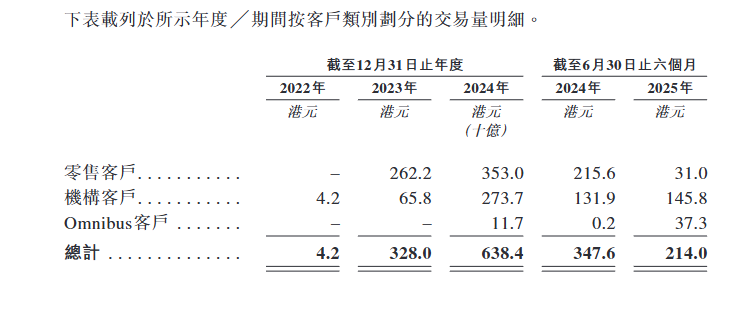
Omnibus clients are also an interesting source of growth. In the second half of 2024, trading volume from these clients was only HKD 200 million, but it surged to HKD 37.3 billion in the first half of 2025. This shows that HashKey is rapidly expanding by indirectly serving end-users through a B2B2C model, collaborating with other platforms or institutions.
Geographically, the Hong Kong market maintained stable growth, but the Bermuda market shrank significantly in the first half of 2025; the reason is the lack of fiat on/off-ramp channels, leading to decreased user activity. This is also the direct reason for HashKey's strategic contraction of its Bermuda business.
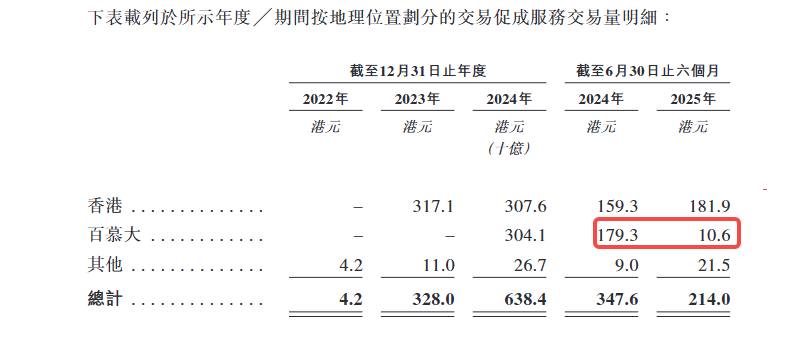
From the user data perspective, HashKey is transitioning from retail-driven to institution-driven, and from direct customer acquisition to partner-driven acquisition.
This is a typical path for a compliant exchange, but it also means that retail-side activity and stickiness still need to be verified.
Financial Truth: Losses Narrowing, But Not Yet Profitable
HashKey's financial condition is improving, but it is still some distance away from true profitability.
Looking at the consolidated income statement, HashKey's losses show a distinct three-stage pattern: a loss of HKD 585 million in 2022, essentially flat at HKD 580 million in 2023, and a sharp increase to HKD 1.19 billion in 2024, almost doubling.
A turning point appeared in the first half of 2025, with a loss of HKD 506.3 million, a 35% narrowing compared to the HKD 770 million loss in the same period of 2024.
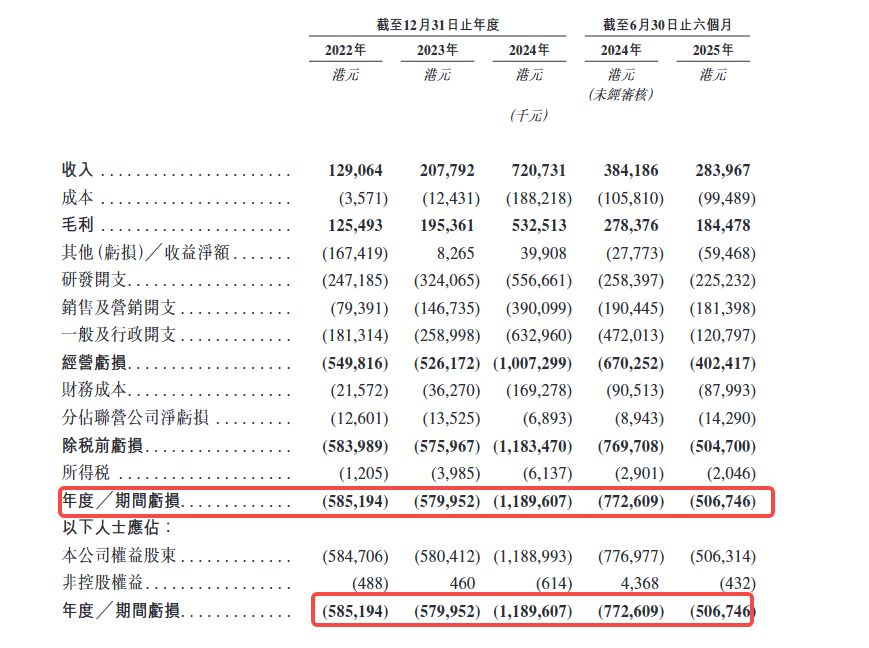
The prospectus discloses that the huge loss in 2024 mainly came from: first, operating losses widening from HKD 526.2 million to HKD 1.0073 billion, an increase of HKD 480 million;
Second, finance costs skyrocketing from HKD 36.27 million to HKD 169.3 million, an increase of HKD 130 million;
Third, "Other net losses" turning from a gain of HKD 8.265 million in 2023 to a loss of HKD 399.1 million, a swing of about HKD 400 million. This last item mainly comes from "Fair value changes in digital assets." During periods of severe market volatility, the book value of digital assets held for market-making and proprietary trading can shrink significantly.
Revenue Down 26%, Trading Business is the Main Drag
Full-year 2024 revenue was HKD 720.7 million, 3.5 times that of 2023. However, first-half 2025 revenue was HKD 284 million, a 26% decrease from HKD 384.2 million in the same period of 2024. Almost the entire decline came from the trading business: commission revenue dropped from HKD 126.1 million to HKD 108 million, and digital asset trading revenue plummeted from HKD 86.68 million to HKD 21.33 million, a 75% drop. The only bright spot was listing fees, which surged from HKD 1.66 million to HKD 43.58 million.
The prospectus attributes this to slowing market trading activity and the proactive contraction of the Bermuda market.
Gross Margin Drops from 72.5% to 65.0%
The gross margin in the same period of 2024 was 72.5%, dropping to 65.0% in the first half of 2025. The reason is that the gross profit from digital asset trading and market-making businesses is highly dependent on market conditions: when the market declines, trading volume shrinks, and held assets can also incur book losses, creating a double squeeze on gross margin.
Shareholding Structure: Who Gets a Piece of the Pie?
In HashKey's shareholding structure, there are three key questions: Who controls this company? Who will benefit from the listing? And, whose equity will those redeemable liabilities ultimately become?
The prospectus discloses that HashKey will have four parties constituting the controlling shareholders:
- Lu Weiding: Non-executive Director, actual controller of Wanxiang Group
- GDZ International Limited: Related entity
- HashKey Fintech III: An affiliated fund of the Company
- Puxing Energy Limited (Stock Code: 00090)
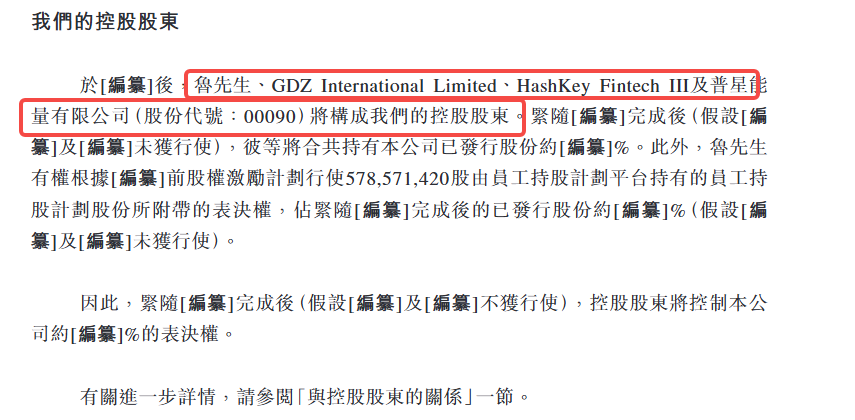
As the prospectus is not yet finalized, the specific shareholding percentages of these four parties have not been disclosed, marked with "[REDACTED]" in the document to be supplemented.
In HashKey's power structure, two names must be mentioned:
Xiao Feng: Executive Director, Chairman of the Board, and Chief Executive Officer. The prospectus refers to him as Dr. Xiao. He is an early promoter of China's blockchain industry, former General Manager of Bosera Funds, and founded Wanxiang Blockchain Labs in 2015. In HashKey's narrative, Xiao Feng is the spiritual leader and strategic architect.
Lu Weiding: Non-executive Director, referred to as Mr. Lu in the prospectus. Chairman of Wanxiang Group. Wanxiang Group is one of China's largest auto parts suppliers and a significant shareholder of HashKey. Lu Weiding effectively controls a large portion of the company's voting rights through direct shareholding and voting rights of an employee shareholding platform.
Lu Weiding also holds a special right: he has the right to exercise the voting rights attached to 578.6 million employee share plan shares held by the employee share plan platform under the pre-listing equity incentive plan. The prospectus discloses that the proportion of these shares to the issued shares post-listing is also pending final determination.
In other words, the controlling shareholders not only hold shares directly but also indirectly control a large number of voting rights through the employee shareholding platform. The prospectus clearly states:
Immediately after the completion of [REDACTED] (assuming [REDACTED] and [REDACTED] are not exercised), the Controlling Shareholders will control approximately [REDACTED]% of the voting rights of the Company.
This is a fairly concentrated shareholding structure, also implying that corporate governance post-listing will heavily rely on the will of the controlling shareholders.
The prospectus also discloses a noteworthy detail:
During the Track Record Period, HashKey Fintech III, GDZ International Limited, and HashKey Fintech II were each one of the Company's top five customers and are controlling shareholders or their associates.
This indicates that HashKey's early revenue was highly dependent on related-party transactions. Although this proportion is declining, it still raises a question: how much of the company's commercialization capability is truly independent?
A similar situation exists on the supplier side. The prospectus discloses that Wanxiang Blockchain entities were among the top five suppliers in 2022, 2023, 2024, and the six months ended June 30, 2025, and are associates of a shareholder of the Company.
Overall, the main beneficiaries of HashKey's listing include:
- Controlling Shareholders: Hold the highest shareholding percentage (specific percentage pending final disclosure) and control additional voting rights through the employee shareholding platform.
- Pre-IPO Investors: After the conversion of redeemable liabilities into shares, they will become significant shareholders. The listing is a key exit window for them.
- Employees: Hold 578.6 million shares through the employee share plan.
- Management: The prospectus discloses that the Company recognized HKD 566.2 million in share-based compensation expenses in 2024, a one-time large-scale grant.
Outside the prospectus, according to the shareholding percentages disclosed by Ryanben Capital, the picture is more detailed and can serve as a cross-reference.
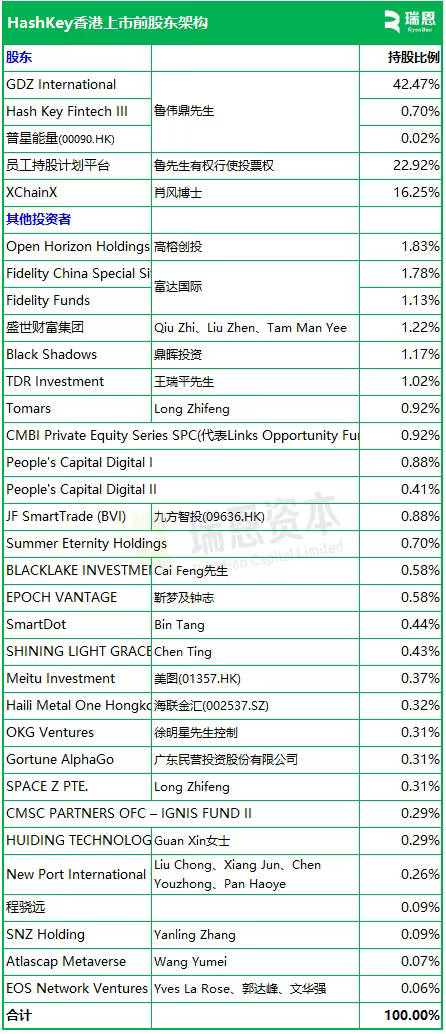
This table confirms the earlier assessment: control is highly concentrated. GDZ International holds 42.47%, plus the employee shareholding platform (22.92%, voting rights exercised by Lu Weiding) and XChainX (16.25%, held by Xiao Feng), the three combined exceed 80%. The actual free float post-listing will be very small.
Notable are several types of roles in the shareholder list:
First, traditional asset management institutions. Fidelity holds approximately 2.9% through two funds, which is not common in crypto company shareholder lists, indicating that HashKey's "compliance narrative" is attractive to traditional institutions.
Second, Hong Kong and A-share listed companies. Meitu (01357.HK), Jiufang Zhitou (09636.HK), and Hailian Jinhui (002537.SZ) are all on the list. For these companies, investing in HashKey is a way to gain crypto asset exposure.
Third, top-tier RMB funds. Gaorong Venture Capital and CDH Investments are early investors. The listing is the main exit window for them.
It's worth mentioning that within the crypto industry, OKX and EOS also participated in the investment.
What to Watch Next
After passing the hearing, HashKey enters the pricing and roadshow stage. According to the HKEX process, the period from the official offer to listing typically takes two to three weeks. At that time, the price range, cornerstone investor list, and specific allocation of fundraising proceeds will become clear.
Several numbers are worth tracking:
First, valuation. Previous Bloomberg reports mentioned fundraising of up to USD 500 million, but the corresponding price-to-sales multiple and whether it trades at a premium or discount relative to OSL can only be calculated after pricing is set.
Second, the composition of cornerstone investors. If traditional financial institutions (banks, brokerages, asset managers) are willing to be cornerstone investors, it indicates institutional buy-in to the "compliant crypto asset" narrative; if it's mainly crypto-native funds or related parties, that's another story.
Third, post-listing trading volume and stock price performance. OSL's stock price has been highly volatile post-listing, with generally low liquidity. HashKey is larger in scale, but the Hong Kong market's pricing power for crypto asset targets remains an unknown.
The prospectus is static; the market is dynamic. This document answers "Who is HashKey," but the question "What is it worth?" will be answered by the market.
Join TechFlow official community to stay tuned
Telegram:https://t.me/TechFlowDaily
X (Twitter):https://x.com/TechFlowPost
X (Twitter) EN:https://x.com/BlockFlow_News
 深潮TechFlow